
A picture of


Commission says 'men in black' may have got cooperation from red shirts
The long-awaited final report from the Truth for Reconciliation Commission of Thailand (TRCT) on the 2010 crackdown, which was obtained in advance by The Nation, shows that the so-called "men in black" had received cooperation from red-shirt guards. It also said that security officers eventually used live bullets, deployed snipers and were likely responsible for the six deaths at Wat Pathumwanaram on May 19, 2010.The 515-page report appeared to hold both sides responsible for the 90-plus deaths and said the clashes on April 10, 2010, where more than 20 people were killed including Army Colonel Romklao Thuwatham, were seminal in creating a climate of animosity between the red shirts and the Army. The report is scheduled to be made public next week.
The men in black and April 10, 2010
"Both [sides] believe they were victims. The operation by the 'men in black' were very instrumental in creating and elevating the violence with the aim of provoking the Army to use weapons against protesters and wanting to exact the loss of lives," page 184 of the report read.
The TRCT explained that after the night of April 10, 2010, the Centre for the Resolution of Emergency Situation (CRES) had started using the term "terrorist" and had permitted security officials to use live bullets for self-defence. Abhisit Vejjajiva's government created the commission with chairman Kanit na Nakorn personally chosen by the premier.
When Colonel Romklao was unexpectedly attacked and killed by a bomb and some senior officers injured, "it led to the confusing and out-of-control use of weapons by soldiers", the report said. It added that soldiers then used rifles and fired "many" live bullets in the direction of the red-shirt protesters. "Many protesters died from bullet wounds," the report stated, without explicitly linking the deaths to soldiers.
The report links at least one of the "men in black" to Army Maj-General Khattiya "Seh Daeng" Sawasdipol, who would later end up being shot down by an unknown sharp shooter on May 13. The report does not reveal the name of the "man in black" believed to be a close aide of Khattiya. On pages 163 and 164, the report says that somebody saw a group of men in black step out of a white van at 7pm on April 10 near the Democracy Monument only to be "surrounded" and escorted by red-shirt guards toward the direction of the deadly confrontation. The guards "barred people from taking photos and some protesters shouted 'a helping hand is here', but were later prevented from speaking".
The report failed to shed light on who might have killed Reuters photographer Hiroyuki Muramoto that night, but it did point out that the first death on April 10 had taken place in front of the Education Ministry when a red-shirt protester was killed by a bullet from an unknown assailant. This was well before the men in black showed up.
Death of Maj-General Khattiya
The TRCT report said that Khattiya, a key red-shirt ally, was shot in the head by a "high-velocity" but unspecified gun on the night of May 13 with bullets that "probably" came from the Silom Plaza Building, which was "under the control of the authorities since April 18".
Six deaths at Wat Pathumwannaram
After Khattiya was killed, violence escalated on both sides and the TRCT report noted a photograph taken by Agence France-Presse, showing what was later examined by weapon experts to be the shell of a live bullet flying out of a soldier's rifle aiming his gun toward protesters. The report noted on page 208 that security officers shot live bullets from both rifles and handguns.
On May 19, at around 10.50am, the report said that clashes occurred between soldiers and armed men in black who were holed up inside Lumpini Park and stated that some protesters may have been killed when bullets were fired from the park.
As for the six killed at Wat Pathumwannaram on the evening of May 19 after demonstrators had been dispersed, TRCT said that on May 19, some 4,000 people had entered the temple, which had been declared a sanctuary area. A sign stating temple's sanctuary status had been posted since May 17, after peace advocates had managed to have the government agree to the idea. The report noted an eyewitness account saying men in black had been spotted inside the temple compound on May 15.
The report noted that: "At around 6pm [of May 19, 2010] seven soldiers were deployed on the first floor of [BTS] Skytrain track in front of Wat Pathumwannaram and five [soldiers] at the Siam Centre BTS Station. All of them were armed with M16 rifles and live bullets.
"It was discovered that officers aimed at and shot in the direction of Wat Pathumwannaram.
On the first-floor Skytrain track, two .223 bullet shells were discovered and they had been fired from the same gun.
What's more, a senior monk at the temple said he had seen a number of soldiers on the Skytrain track and had heard my gunshots fired around the front of the temple at dusk.
"It is highly likely that this was the cause of the deaths and injuries around Wat Pathumwananram," the report concluded, adding that one soldier told the TRCT that he had fired into the temple because there was an armed man in black on a tree inside the temple.
An M16 was later discovered inside the temple, the report added.

Suryavarman II, (died c. 1150), Cambodian king renowned as a religious reformer and temple builder. Under his rule the temple of Angkor Wat, the world's largest religious structure, was constructed.
Suryavarman defeated rival claimants to the throne and established sole rule over Cambodia by 1113, reuniting the country after more than 50 years of unrest. Warlike and ambitious, he expanded the limits of Cambodia to include much of what is now Thailand; his patronage stretched as far west as the frontiers of the Burmese state of Pagan, south to the coast of the Gulf of Thailand (including part of the eastern coast of the Malay Peninsula), and east to the kingdom of Champa in the southern part of what is now Vietnam.
Suryavarman was formally crowned in 1113, with his guru, the powerful priest Divakarapandita, presiding. The king was a religious reformer who blended the mystical cults of Vishnu and Shiva, supreme Hindu deities, and promulgated Vaishnavism as the official religion, rather than Buddhism, which had briefly flourished under his predecessors.
Angkor Wat, dedicated to Vishnu, was begun in the early years of Suryavarman's reign and was not finished until after his death. Surrounded by a wall and a moat, the building is decorated with sculptures portraying Suryavarman as Vishnu; he is shown reviewing his troops, holding audiences, and performing other functions of a sovereign. Suryavarman also sponsored the construction of several other temples in the style of Angkor Wat. After his death, Angkor Wat also became his tomb.
In 1116 Suryavarman resumed diplomatic relations (in abeyance since the 9th century) with the Chinese, who officially recognized his kingdom as their vassal in 1128. By sending tribute to China, he acquired a powerful ally to discourage attacks from neighbouring Southeast Asian kingdoms and ensured that China would not interfere in Khmer domestic affairs.
From 1123 until 1136 Suryavarman waged a series of unsuccessful campaigns against Dai Viet, the Vietnamese kingdom that had asserted its independence from China in 939. He attempted a land attack through Laos to Nghe An in 1128 and met with defeat. A few months later, Suryavarman's fleet of 700 junks began a long harassment along the coast in the Gulf of Tonkin. Suryavarman persuaded the kingdom of Champa to assist him in these efforts, but in 1136 the Cham king, Jaya Indravarman III, defected and made an alliance with the Vietnamese.
Suryavarman deposed the Cham king in 1144 and annexed Champa in the following year. The Chams, under a new leader, King Jaya Harivarman I, defeated Khmer troops in a decisive battle at Chakling, near Phan Rang, in southern Vietnam. Suryavarman put his brother-in-law, Harideva, on the Cham throne, but Jaya Harivarman I deposed him and reclaimed that throne. In 1150 Suryavarman died in the midst of a new campaign against Champa, leaving his people exhausted by war and victimized by the once-subservient Chams, who eventually ravaged Angkor.

DAMASCUS: Security forces shot dead a mourner at a huge funeral on Saturday for demonstrators killed in rare protests in the Syrian capital, as a senior Chinese envoy issued a plea for the bloodshed to end.
The Damascus funerals were for four people, two of them teenagers, killed when security forces fired on protesters in the capital's Mazzeh district, which is overlooked by the presidential palace and houses many government offices and embassies, a human rights group and activists said.
"The funerals in Mazzeh turned into protests - it was the closest major gathering to Omayyad Square" in the city centre, the head of the Syrian Observatory for Human Rights, Rami Abdul Rahman, told AFP.
Mohammed Shami, a spokesman for activists in Damascus province, echoed him.
"It's the first time there have been demonstrations of such a scale so close to the centre of Damascus," Shami said, adding that some 15,000 people had turned out despite snowfall.
He said the shootings, in which many people were wounded, were followed by a "wave of searches and arrests" across the leafy, upscale residential district.
"People hid wherever they could," he said. "State television didn't cover what happened even though it was only a short distance from the Radio and Television Organisation."
Activists described Friday's demonstrations in Damascus as "unprecedented", saying there were 49 in all, and called for a "day of defiance" in the capital on Sunday to galvanise support.
"We said from the onset that the day when huge demonstrations will spill out in Damascus and (Syria's second city) Aleppo, it will be the end of the regime," said Agnes Levallois, a Paris-based Middle East expert.
The continuing onslaught on the rebel city of Homs "has spurred many Syrians, who were still hesitating, to join the protest movement", said Levallois. "The wall of fear has really crumbled."
The Syrian Observatory said the security forces killed a total of at least 11 civilians across the country on Saturday.
In a message to Damascus residents on their "Syrian Revolution 2011" Facebook page, activists said: "The blood of the martyrs exhorts you to disobedience."
Security forces also kept up their pounding of the flashpoint central city of Homs as the Chinese envoy visited.
Rockets crashed into strongholds of resistance at the rate of four a minute on Friday, according to one activist. He warned that the city, Syria's third largest, faced a humanitarian crisis.
Thirteen of the 30 people killed on Friday were in the Homs district of Baba Amr, the Observatory said.
After morning talks with President Bashar al-Assad, Chinese Vice Foreign Minister Zhai Jun called on all sides to stop the violence and for planned elections, which have been denounced by the opposition, to go ahead peacefully, state media said.
Zhai, whose government has twice joined Russia in blocking UN Security Council condemnation of the Damascus regime's crackdown, said it was vital that "calm be restored as quickly as possible," state television reported.
"The position of China is to call on the government, the opposition and the rebels to halt acts of violence immediately," Zhai said, on the second day of talks with Syrian officials.
"We hope that the referendum on a new constitution as well as the forthcoming parliamentary elections pass off calmly," he added.
"China supports the reforms under way in Syria and the significant measures taken by the country in this field."
Assad said the unrest in Syria was "aimed at dividing the country and delivering a blow to its geopolitical position and historical role in the region," the official SANA news agency reported.
The office of Iraqi Prime Minister Nuri al-Maliki office said in a statement Baghdad was taking measures to secure its border with Syria against weapons smuggling and the unauthorised movement of people.
On Thursday, Syrian opposition groups rejected a newly drafted constitution that could end nearly five decades of single-party rule, and urged voters to boycott a February 26 referendum on the charter.
Deputy Interior Minister Hassan Jilali said that more than 14 million Syrians will be eligible to vote in the referendum, SANA reported, adding that 13,835 polling stations have been set up across the country.
Meanwhile, Hollywood star and UNHCR goodwill ambassador Angelina Jolie appealed for "intervention" in Syria, telling Al-Jazeera Balkans television: "It's so sad, so upsetting, it's so horrible what's happening."
And in the United States, NBC television reported that US drones were overflying Syria to monitor the violence, which activists say has left more than 6,000 people dead since last March.
VIEW SOURCE FROM http://www.channelnewsasia.com/stories/afp_world/view/1183889/1/.html

DAKAR: Senegal riot police clashed with rock-throwing protesters on Saturday, firing teargas and water cannon for the fourth day running as fresh violence hit the capital a week before highly divisive polls.
The opposition has been banned from protesting in central Dakar, leading to a second day of cat-and-mouse battles with police in the seaside capital who are trying to prevent them from gathering at Independence Square.
Police said a young Senegalese man died Saturday of wounds sustained in a demonstration the previous day in the country's second city of Kaolack.
The protesters are demanding 85-year-old President Abdoulaye Wade leave office as fury mounts over his candidacy for a third term in power in February polls.
Earlier in the afternoon the streets bustled despite the threat of a protest but quickly chaos erupted as a group of about 100 people converged in Avenue William Ponty leading up to Independence Square, which was cordoned off by riot police.
With their hands held in a cross above their head they chanted in Wolof "Na Dem Na Dem" (He must leave) referring to Wade. Police fired teargas to disperse them and they riposted with rocks.
A short while later several black pickups, sirens blaring, bearing the image of presidential candidate and former prime minister Idrissa Seck, and loaded with men in black balaclavas drove up and started throwing rocks at police.
A water cannon came in and more volleys of breath-stopping teargas choked protesters who went running off into side streets.
Youths regrouped from a sidestreet and marched straight towards the square, again meeting fierce resistance from police. Debris and wooden tables used by market women were dragged into the road and set alight by protesters.
Red Cross reported that two people had been injured.
Meanwhile the young man killed in Kaolack was reported in local media as having being hit by a teargas grenade fired by officers during a protest against the alleged desecration by police of a Dakar mosque.
Violence also erupted Friday night in the western city of Tivaouane, capital of the nation's largest Islamic brotherhood, the Tidianes, after police threw teargas into one of their mosques in Dakar.
The APS news agency reported that the mayor's office was torched and protesters set up burning barricades.
For three days protesters have attempted to rally in Dakar and police have dispersed them, using teargas, rubber bullets and water cannon.
International Federation of Human Rights (FIDH) president Souhay Belhassen said in a joint statement with local rights bodies: "The authorities must come to their senses and allow political and public expression of opponents and citizens or be seen as an authoritarian regime muzzling democracy."
"We reiterate the peaceful nature of M23, but as long as the protests are banned, clashes can be expected," said movement spokesman Abdoul Aziz Diop.
The FIDH said the ban on protests was illegal as the electoral code allows candidates to "freely organise meetings and protests..." when they give 24 hours notice to authorities.
"On the eve of such an important date for Senegal, the country's highest authorities must act responsibly and calming, allowing for the free expression of democracy as required by law," read the statement.
The rights bodies said Wade's latest term in office had been "marked by regressions in human rights".
Tomaso Caprioglio, deputy chief of the European Union observer mission, kept watch as troops voted, saying the EU mission "deplored all violent acts and hopes the situation will normalise in the coming days to allow for a calm and peaceful election" on February 26.
Despite having served two terms in office, a limit he introduced, Wade says additional changes to the constitution in 2008 mean he can serve two more mandates, giving him more time to finish his "Grand Projects".
The country's highest legal body approved his candidacy on January 27, sparking riots in the capital and elsewhere that left four people dead.
Since the official election campaign kicked off, Wade has swept energetically through the country promising universities, roads, airports and massive agricultural projects to win over five million registered voters.
The 13 opposition contenders, which include three of Wade's former prime ministers, failed to find a consensus candidate before the campaign.
Some 23,000 soldiers and paramilitary police began voting Saturday.
- AFP/de
VIEW SOURCE FROM http://www.channelnewsasia.com/stories/afp_world/view/1183879/1/.html

BANGKOK, Feb 19 -- Police are seeking court approval to issue an arrest warrant for the fifth suspect possibly involved in the explosions in Bangkok's Sukhumvit area on Tuesday, according to Pol Gen Pansiri Prapawat, deputy national police chief overseeing the case.
Gen Pansiri told reporters on Saturday after a meeting of investigators that they resolved to seek court approval for an arrest warrant for the fifth suspect, a Middle Eastern man who appeared on CCTV footage.
The CCTV captured images of him walking from the rented house where the first bomb apparently exploded by accident.
According to the CCTV record, he had left the house between 7-8 am, and the first explosion occurred at a rented house in Sukhumvit 71’s Soi Pridi Panomyong 31 that afternoon.
He said the investigation so far did not find any Thais involved with the blasts.
National Police Bureau Chief Pol Gen Priewpan Dhamapong earlier said that the fifth suspect has already left Thailand.
Thailand’s Criminal Court on Thursday issued arrest warrants for four Iranians on various charges related to Tuesday’s Bangkok bomb incidents.
Two Iranian suspects were arrested earlier -- Saeid Moradi, 28, who lost both legs from his own explosive device -- and another suspect, Mohammad Hazaei, 42, who was taken into custody at Suvarnabhumi Airport on Tuesday while attempting to board a plane bound for Malaysia.
A third Iranian - identified as Masoud Sedaghatzadeh - was arrested on Wednesday by Malaysian authorities in Kuala Lumpur, and Thai authorities were requesting to extradite him to Thailand for prosecution.
Regarding a fourth suspect, an Iranian national identified as Rohani Leila, Immigration Bureau Commissioner Pol Lt Gen Wiboon Bangthamai cited intelligence reports that she returned to the Iranian capital of Tehran.
Ms Rohani was identified as the person who rented the house at Sukhumvit 71’s Soi Pridi Panomyong 31.
Meanwhile, the forensic experts and the Explosive Ordnance Disposal (EOD) unit have inspected a motorcycle that was bought by one of the suspects under an outstanding arrest warrant.
The motorcycle was parked in front of an electrical appliance shop not far from Sukhumvit 71’s Soi Pridi Panomyong 36 and the owner of the shop informed police that he saw the suspect riding the motorcycle and parking in front of his shop before walking to the rented house everyday.
According to the investigation, police said that the motorcycle was used by Mr Sedaghatzadeh. He bought from a shop in Khlong Ton districe since December.
After a search of the motorcycle, police found six 5x10 cm stickers which were the same as those found when police searched a room at Nasa Vagas Tower, rented by Ms Rohani.
Police said that at the moment they could not specify whether or not the motorcycle was involved with the blasts as further investigation was needed. (MCOT online news)
VIEW SOURCE FROM http://www.mcot.net/cfcustom/cache_page/332561.html

BANGKOK, Feb 16 - Thai Foreign Minister Surapong Tovichakchaikul on Thursday said that 14 countries have issued travel advisories warning their citizens to be careful while visiting Thailand following Tuesday’s blasts in the capital.
The 14 countries are Canada, the United States, Ireland, the United Kingdom, Austria, the Netherlands, Japan, South Korea, Brazil, New Zealand, Italy, Norway, Israel and Taiwan, according to the minister.
The foreign minister expressed confidence that the negative situation will not be prolonged as the Thai authorities were able to detain almost all the suspects. It remains unclear whether or not the incidents are terror attacks targeting Israeli diplomats.
"Iran is ready to cooperate with Thailand to investigate the detainees' nationality so that it will become clear which group is responsible for the bomb incidents," Mr Surapong said.
Regarding the arrest of a third Iranian by Malaysian authorities, the minister said the extradition of the detainee to Thailand is being sought.
Mr Surapong said that a company which facilitated the arrival of the detained Iranians as tourists will be questioned, and that he will direct Thai embassies worldwide to impose a stricter process when issuing visas.
The foreign minister reaffirmed that Thailand is friendly with every country and that it has no involvement in any conflict between other countries. He said that the explosion in the heart of Bangkok was not terrorism as the target was a particular person.
Meanwhile, the Tourism Authority of Thailand (TAT) on Thursday reported that no room reservations were cancelled in Sukhumvit area, the vicinity of Valentine's Day blasts, but the authorities must still assess the situation in the coming months.
TAT Deputy Governor Sansern Ngaorangsri said the 22 TAT offices around the world were asked to monitor foreign media coverage on the blasts and clarify the incidents with tour agencies.
Thai Hotels Association president Prakit Shinamornpong on Thursday reaffirmed that no room cancellations were made by foreign visitors since the blasts occurred on Tuesday as he inquired the association's members which operate their businesses in Sukhumvit and Ratchaprasong areas.
Mr Prakit said hotel bookings in Phuket, Pattaya and Koh Samui are unaffected by the incidents.
The hotel trade association executive urged state agencies to clarify the security measures to restore confidence among the visitors that travelling in Thailand is still safe. (MCOT online)
VIEW SOURCE FROM http://www.mcot.net/cfcustom/cache_page/331784.html

BANGKOK, Feb 14 – Cambodia and Thailand will open a new permanent checkpoint and will conduct a joint survey for border demarcation in agreements reached during their two days of border talks in Bangkok.
The meeting of the 5th Thai-Cambodian Joint Boundary Commission concluded here on Tuesday with agreement that a new permanent checkpoint will open at Nong-ian in Thailand’s Sa Kaeo -and Stung Bot in Cambodia’s Bantey Meancheay on March 5.
Bandhit Sotipalarit, chairperson of Thai delegates and his Cambodian counterpart Var Kim Hong held a joint press conference after the two-day meeting ended on February 14.
The meeting also approved surveying and installing boundary markers 1-23.
The two sides also discussed taking aerial photographs and agreed that technicians will specify qualifications and select a company to do the task, paving the way for border demarcation.
The talks were straightforward ending with agreement to give priority to easy tasks first before moving on to difficult ones. Any debatable issues will be postponed and will be later vetted by the two sides again, said Mr Bandhit.
Meanwhile, Mr Hong said the talks, resumed after a two-year suspension, helped renew close relations between the two countries.
He said he expected more talks on other matters will be carried out in the future. (MCOT online news)
VIEW SOURCE FROM http://www.mcot.net/cfcustom/cache_page/331213.html

On Monday, an Israeli diplomat's wife and driver were wounded in New Delhi when a bomb attached to their minivan exploded, and another device was defused on an Israeli embassy car in Tbilisi, Georgia.
Speaking at a news conference after a one-hour meeting of the National Security Council (NSC), Secretary-General Wichean Potephosree said preliminary investigation indicated that the blasts were targeting individuals. Although the investigation found no link with terrorism, further investigation is needed.
Gen Wichean said the bombs being assembled here using magnets resembled the bombs targeting Israeli diplomats in India and Georgia.
Despite Israel accusing Iran of being behind the violence, the NSC chief said more investigation will be carried out to verify such a claim.
Iran denied responsibility for the India attack and the foiled bombing of an Israeli diplomatic mission car in the Georgian capital on Monday.
Meanwhile, Deputy Police Chief Pol Gen Pansiri Prapawat said more evidence is being collected to seek an arrest warrant against the third suspect believed to have fled the country, possibly into Malaysia.
The three suspects, all men, were reported to have fled a rented house in Soi Pridi Banomyong 31 off Sukhumvit 71 Road where the first bomb exploded, blowing the roof off the building.
An Iranian national identified as Saeid Moradi was seriously injured by his own hand grenade when confronted by police officers in a squad car. He hurled the grenade at them, but it bounced back from the vehicle. The explosion tore off his legs.
The second bombing suspect, an Iranian identified as Mohammad Hazaei, was taken into custody at Suvarnabhumi Airport while attempting to board a plane to Malaysia, and has been transferred by police for further questioning at Khlong Tan station. (MCOT online news)
VIEW SOURCE FROM http://www.mcot.net/cfcustom/cache_page/331214.html

The Democrats will raise three questions for the prime minister to answer during the House session on Thursday, chief opposition whip Jurin Laksanavisit said on Tuesday.
In the first question, Prime Minister Yingluck Shinawatra should explain why she had attended a private function at the Four Seasons Hotel last Wednesday.
In the second question, the Democrats want to hear the justification for Education Minister Suchart Thadathamrongvej’s policy to legalise tea money for school enrolment, calling it a donation instead.
The third question is about the government’s decision to make compensation payments to victims of southern violence, including those involved in criminal activities and the destruction of government property.
Jurin said the Democrats viewed the compensation as arbitrary because of three flaws - perpetrators to benefit, coverage for selected incidents only and leaving out victims of other state abuses, such as those who died in the silent killings during the war on drugs.
The Democrats will pose their queries at the question-and-answer session even though PM Yingluck and 15 Cabinet members are on a four-day tour of the flood-prone areas in the North.
In the past six months, Yingluck has replied to only three questions raised from the House floor. Last week, she ignored all 26 questions from the opposition and chose to answer one posed by the ruling Pheu Thai Party
VIEW SOURCE FROM http://www.nationmultimedia.com/politics/Democrats-to-question-PM-on-three-issues-30175840.html
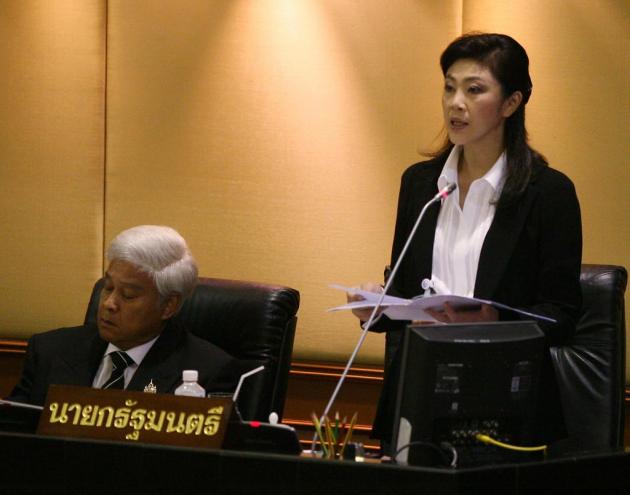
Ministers endorse ruling party bill seeking to amend Article 291 and form a constitutional drafting assembly
The Cabinet yesterday endorsed a government bill seeking to amend Article 291 of the 2007 charter and allow the formation of a constitution drafting assembly.Prime Minister Yingluck Shinawatra said after the Cabinet meeting that the 99 constitution drafters - one elected in each of the 77 provinces and 22 appointed from legal and political science experts - would be given a free hand to amend the entire post-2006 coup charter.
When asked why the administration had made an about-turn from its previous position of not seeking charter changes by itself, Yingluck said the government did not want to lose the right to propose its own amendment draft after different groups - including the ruling Pheu Thai Party and the red shirts - had separately submitted their own drafts for parliamentary deliberation.
The prime minister also said constitutional amendment was part of her government's "urgent policies" declared before Parliament when it assumed office last August.
"The government did not want to start with charter amendment, as we wanted to focus on tackling the country's problems. But now that other groups have started their moves, the government does not want to lose its right to have its own draft for parliamentary deliberation along with the other drafts."
She also said the government draft would only seek changes to Article 291, which would pave the way for establishment of a constitution drafting assembly.
"The CDA will decide how to amend the Constitution. The government will have no involvement. And I insist this will have nothing to do with Thaksin [Shinawatra, ex-premier]," Yingluck added, in response to suspicions the changes would benefit her brother, who fled into exile prior to a criminal conviction by the Supreme Court several years ago.
A coalition source said the government's about-face had resulted from Thaksin having a change of heart on the issue. Thaksin earlier did not want the government to get involved with charter amendments, preferring that coalition politicians did so under Pheu Thai's name. But he changed his mind after seeing that opposition did not appear to be strong, the source said.
During the Cabinet meeting on the amendment bill, which lasted about 30 minutes, Deputy Prime Minister Chalerm Yoobamrung described the draft - prepared by the Justice Ministry - as "the best, most classic and most beautiful", according to a Government House source.
Chalerm said the draft would allow public participation from the beginning through to the end of the amendment process, with election of CDA members and a public referendum on the CDA's final changes.
Meanwhile, deputy government spokesman Anusorn Iamsa-ard said he had been assigned by the PM to invite all elements of society to take part in the process. He said public hearings would also be held.
VIEW SOURCE FROM http://www.nationmultimedia.com/politics/Cabinet-backs-charter-change-30175818.html

A political pressure group linked to the yellow shirts petitioned the Ombudsman's Office yesterday for an investigation into alleged misconduct by Prime Minister Yingluck Shinawatra in connection with her recent appearance at a Bangkok hotel.
The Green Politics group, represented by Jaturan Boonbenjarat, asked the agency to investigate whether the premier had violated any code of conduct for doing "personal business during work time" and failing to provide a satisfactory explanation to the public.Sa-ngad Patthawi, deputy secretary-general of the Ombudsman's Office, said after accepting the petition he would forward it to the ombudsmen at their next meeting - tomorrow, when they will decide whether to investigate the matter.
Last week, government critic Akeyuth Anchanbutr said that he saw Yingluck on Wednesday afternoon at the Four Seasons Hotel. He claims he was assaulted by someone in the PM's security team, but this has been dismissed by many government figures.
Yingluck insisted later she "did not do anything wrong" during her visit to the hotel, and rejected Akeyuth's suggestion of indecent conduct.
Jaturan said yesterday that Green Politics had requested the Ombudsman's Office to urgently look into the matter. He said the prime minister's explanation failed to clear suspicion that she skipped a parliamentary meeting that day for personal business at the hotel.
"If that matter she was involved in at the hotel had something to do with public interest, why didn't she tell the public?" he said.
Akeyuth, a staunch critic of Yingluck's brother, ex-premier Thaksin, challenged Deputy Prime Minister Chalerm Yoobamrung yesterday to conduct a joint press conference about his claim he was attacked by a man working for Thaksin. He was responding to Chalerm's denial of his claim.
Akeyuth said he might change his mind and file a complaint with police about the alleged attack.
Chalerm yesterday turned down Akeyuth's challenge for him to join a joint press conference. Chalerm said he had nothing to do with the matter and repeated his call for Akeyuth to file a complaint to police "to make things easier". He also dismissed Akeyuth's remark that Chalerm knew the identity of Akeyuth's alleged attacker.
VIEW SOURCE FROM http://www.nationmultimedia.com/politics/Ombudsmen-asked-to-look-into-PMs-conduct-at-hotel-30175820.html

Thammasat University's board yesterday made a U-turn on its earlier decision to prohibit the use of its campus for campaigns against the lese majeste laws.
A statement issued after an executive committee meeting stated that in principle, the university allowed all campaigns on its campus - but organisers of the campaigns must be responsible that activities are conducted within the legal framework. They must not provoke violence among people of different opinions, and must end as scheduled and not obstruct traffic or cause trouble.The board also announced that if any activity on campus appeared to create confrontation, the university would need to take certain measures to prevent violence.
"Thammasat still has freedom in every square inch. The land of Thammasat is still full of academic freedom as well as freedom of expression," the statement read.
'Not discriminatory'
The board said strict rules on using its campus issued by the board were not discriminatory but would apply to both sides in any debate.
The Thammasat University board decided two weeks ago to ban the use of its facilities by campaigners against the lese majeste law - a move that applied more heat to the controversial Nitirat group and caused an uproar among the group’s supporters. The reason behind the decision was the fear of conflict and chaos on the campus. The university since then has been urged to review the decision as it was seen to affect freedom of expression.
Asked whether the Nitirat group, which advocates changes to the law, will be allowed to continue its activities regarding Article 112 of the Penal Code, deputy rector Pornchai Trakul-waranont said during the conference that the university committee would consider cases individually. "Everyone can hold activities on the campus as long as the activities don't lead to chaos or confrontation but are expressions of purely academic views," he said.
VIEW SOURCE FROM http://www.nationmultimedia.com/politics/TU-lifts-ban-on-campus-campaigns-30175817.html

Prime Minister Yingluck Shinawatra began a five-day trip yesterday to inspect flood prevention work and try to restore confidence in the government's ability to avoid another disastrous flood this year, but she will need much more than charm and a good sartorial sense.
A day before her trip covering half a dozen provinces, Dusit Poll revealed many respondents found the government's handling of flood concerns to be its least competent work so far.Opposition leader Abhisit Vejjajiva demanded on the weekend that the government be transparent about locations to be designated as water catchment areas. Abhisit accused Yingluck of being unwilling to reveal details for fear of protests by affected villagers.
Public Health Minister Witthaya Buranasiri has said it would be cheaper and more reasonable for residents in the province of Ayutthaya to accept compensation money in advance, so their homes and land can be designated as water catchment areas - as it will take at least two years to complete any meaningful flood-prevention construction.
There is much different information, plus many activities and complaints swirling in the public consciousness, but no master plan yet that people can pick up and learn the details about short, medium and long-term policy.
Smith Dharmasaroja, a key member of the government-appointed Strategic Committee for Water Resources Management (SCWRM) - who arrived at Sirikit Dam three hours in advance of the premier yesterday - was asked about the master plan, but said it's nowhere to be found yet.
"This is what I get criticised for when I speak out, for causing damage, though in fact [my comment] is not criticism but a reminder. We allocated a Bt150-billion budget and there's no blueprint whatsoever yet," he said.
"So what will we say to foreign investors? The [recent] re-flooding of an area in Ayutthaya has people frightened."
Smith said it made more sense, for example, for industrial estates in Ayutthaya be relocated elsewhere on higher ground, such as in Nakhon Ratchasima province.
Instead, billions will be spent building dyke walls around industrial estates likely to be surrounded by water from all sides, at the peak of the wet season, with transportation almost impossible. It seems to make little sense.
No matter how reassuring and charming Yingluck's smiles are to the people she will visit in the next few days, one cannot expect her charm offensive will have any impact in holding back the tide. Flooding is indiscriminate and it cannot be ordered around or charmed by a premier's smile, as was proven very clearly late last year.
VIEW SOURCE FROM http://www.nationmultimedia.com/politics/People-in-flood-prone-regions-want-more-than-just--30175821.html

Plodprasob concerned about drainage; PM promises drought relief
Tuesday is the second day of the flood-inspection tour and Prime Minister Yingluck Shinawatra is scheduled to inspect Phitsanulok, Phichit and Nakhon Sawan.
After spending the night at a Phitsanulok hotel, Yingluck and selected Cabinet members will be given a briefing on flood prevention plans for the upstream provinces.
Governors of ten upstream provinces -- Chiang Mai, Chiang Rai, Sukhothai, Uttaradit, Tak, Nan, Phrae, Lampang, Lamphun and Phayao -- are scheduled to meet with the prime minister today in Phitsanulok to propose their integrated flood prevention plan.
Phitsanulok Governor Preecha Ruangchan said he planned to propose building more dykes along the river and raising existing dykes from 50 centimetres to one metre high in a bid to prevent flooding in the province's economic zone.
Yingluck and a number of cabinet minister on Monday began a 5-day tour visiting the lower northern province of Uttaradit to review water management at the Sirikit Dam, which she said would become a model for other dams.
Science and Technology Minister Plodprasob Surasawadi briefed the premier saying that Thailand would encounter typhoons and tropical storms this year while the sea level is expected to rise slightly from last year.
Plodprasob expressed concern regarding water drainage as the total amount of water is predicted at 20 billion cubic metres. Existing dams must keep five billion cubic metres of water, with another five billion in other water retention areas.
The remaining 10 billion cubic metres of water should drain through Bangkok, taking 45 days, according to the minister, who reaffirmed that Bangkok will not be flooded.
Yingluck stated concerned agencies should speed up the reforestation in upstream areas and the building of the so-called monkey cheeks projects (a water organisation system draining waterways such as ditches and canals into small reservoirs).
She said the interior ministry and the ministry of natural resources and environment will be in charge of the planting of vetiver grass, while dam authorities must manage their water level to least affect the public.
The premier however admitted that some groups of people will be hit by drought as a result of water management in dams but the government will rehabilitate them at its full capacity.
The meteorological and warning system should be improved and information must be integrated from all concerned parties, asserted the premier, adding this improvement should be completed within three months.
The prime minister will later travel to Phichit. She is scheduled to inspect Khlong Klam, the location for Bang Rakam monkey cheek project for water retention. Bang Rakam is one of the worst flood-prone areas in the upper North.The prime minister will stop off for lunch at Pheu Thai Party’s office in Phichit before inspecting a flood control project at Bung Si Fai.
The next stop is at the Bung Boraphet flood control project in Nakhon Sawan where the prime minister will spend the second night of the trip.
VIEW SOURCE FROM http://www.nationmultimedia.com/politics/Yingluck-inspects-three-provinces-in-a-day-30175832.html

Accompanied by her ministers, Ms Yingluck is due to visit the first destination in the lower northern province of Uttaradit to review water management at Sirikit Dam on Monday.
About 200 plainclothes and uniformed police officers have been deployed to provide security to the prime minister during her visit, said Uttaradit Deputy Governor Nawin Sinthusa-ard.
The premier’s upcountry trip is scheduled to run from today through Friday (Feb 13-17). Today the premier will visit Sirikit Dam in Uttaradit.
After that she will travel to inspect a water resource development project and a water retention area in Phitsanulok’s Bang Rakam district before leaving for Nakhon Sawan to observe other water management projects aimed at preventing flooding, as well as the Bueng Boraphet freshwater swamp.
In Chai Nat, she will follow up improvements of water management at Chao Phraya Dam and other sluice gates before visiting a water retention area in Lop Buri.
Ms Yingluck will convene a meeting on a flood prevention plan for downstream areas with representatives from industrial sectors and entrepreneurs in Ayutthaya before returning to Bangkok on Friday. (MCOT online news)
VIEW SOURCE FROM http://www.mcot.net/cfcustom/cache_page/330252.html


